

In the professional world, documenting discussions is necessary for maintaining accountability and historical context. However, confusion often arises regarding whether to use informal meeting notes or structured meeting minutes. While both serve to capture information, they differ significantly in their intended audience, legal weight, and level of detail. This guide provides a comprehensive breakdown of these two documentation styles to help you choose the right approach for your next professional gathering.

Meeting Notes vs. Meeting Minutes: The Core Difference
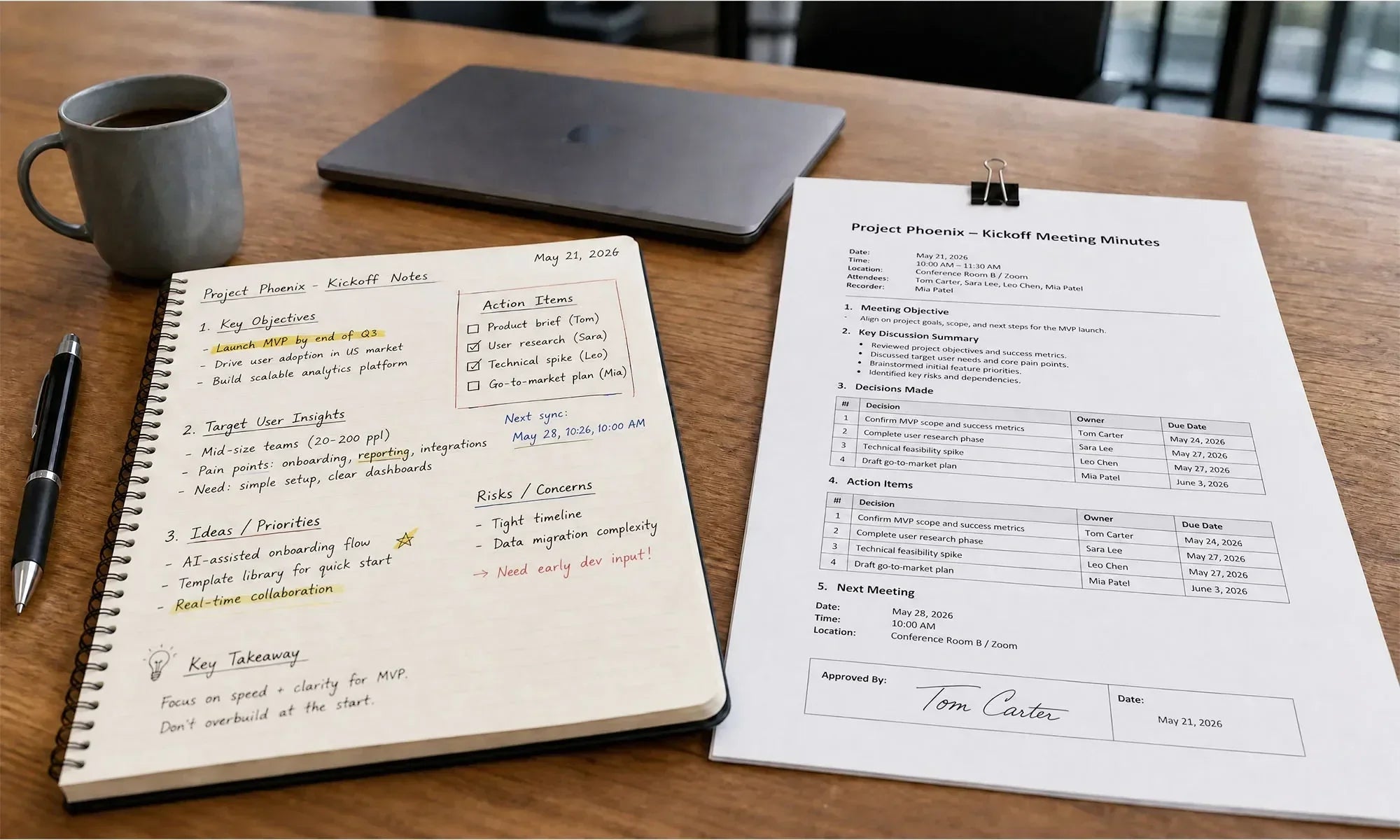
The primary distinction between these two formats lies in their formality and authority. Meeting minutes are the official, legal record of a meeting, whereas notes are generally used for personal reference or internal team alignment.
Legal and Official Status
Meeting minutes often serve as a legal document, especially in board meetings or government proceedings. They are formally approved by the participants and can be used in court or during audits. Conversely, meeting notes are informal and usually lack the official standing required for high-stakes corporate governance or regulatory compliance.
Structure and Standardization
Minutes follow a standardized format and focus on decisions made rather than every word spoken. Notes are unstructured, often containing bullet points, sketches, or shorthand that may only make sense to the person who wrote them. While minutes are designed for a wide audience, notes are often intended for a specific individual or a small, close-knit group.
Finality and Persistence
Meeting minutes are "locked" once approved, creating a permanent record that remains unchanged over time. Notes are dynamic and can be updated, expanded, or discarded once the tasks they describe have been completed. This difference makes minutes the better tool for long-term archiving and notes the better tool for immediate project management.

What Are Meeting Notes?
Meeting Notes are informal records captured during a discussion to help participants remember key ideas, context, and immediate action items. They prioritize speed and utility over perfect formatting or comprehensive detail.
Personal vs. Team Reference
Most notes are created for personal use. A project manager might use them to track why a specific design choice was made, while a developer might use them to list technical requirements discussed during a sprint. When shared with a team, they serve as a "quick start" guide for the work ahead rather than a historical archive.
Focus on Insights and Context
Unlike minutes, which record results, notes often record the "why." They may include brainstorming ideas that were ultimately rejected, internal emotional cues of the group, or side conversations that provide valuable context for future projects. This makes taking meeting notes an excellent way to preserve the creative energy of a meeting.
Flexibility in Format
There is no "wrong" way to take notes. Some professionals prefer digital tools, while others use physical journals. The format can change depending on the meeting type—a one-on-one check-in requires a different note-taking style than a cross-departmental town hall.
What Are Meeting Minutes?
Meeting minutes are formal, summarized accounts of a meeting’s proceedings. They are designed to provide a clear, objective overview of the motions proposed, the votes taken, and the official outcomes reached during the session.
The Role of the Secretary or Scribe
In a formal setting, a designated individual is responsible for recording minutes. This person must remain neutral, avoiding personal bias or interpretation of the speakers' intent. Their goal is to capture the "official" version of events that all attendees can agree upon.
Objective and Result-Oriented
Professional minutes do not record every detail of the debate. Instead, they focus on the "resolutions." For example, instead of listing every argument for and against a budget increase, the minutes would simply state: "The board discussed the budget proposal, and a motion to increase the marketing spend by 10% was carried by a majority vote."
Approval and Verification Process
A defining feature of minutes is the approval cycle. Typically, minutes from the previous meeting are distributed, reviewed for accuracy, and formally "seconded" or approved at the start of the next meeting. Once approved, they become the definitive record of the organization’s actions.
When Should You Use Meeting Notes vs. Meeting Minutes?
Choosing between formal vs informal meeting records depends on the nature of the meeting and the potential consequences of the decisions being made. Not every internal sync requires a legal record, but every high-level board meeting does.
Scenarios for Informal Records
Informal notes are best suited for:
- Daily stand-ups or status updates.
- Brainstorming sessions and creative workshops.
- Initial client discovery calls.
- Internal team debriefs after a project milestone.
In these cases, the speed of information sharing is more valuable than a rigid, formal structure.
Scenarios for Formal Minutes
Formal minutes are mandatory or highly recommended for:
- Board of Directors meetings.
- Shareholder or annual general meetings.
- Public committee or government hearings.
- Disciplinary hearings or legal negotiations.
These meetings require a level of accountability where "he said, she said" disputes must be avoided at all costs.
Hybrid Approaches
Some modern organizations use a hybrid model. They might record a casual team meeting with AI-generated transcripts to serve as the "raw" notes while maintaining a short, one-page summary of key decisions to serve as the "lite" minutes. This ensures both context and clarity are preserved without excessive administrative overhead.

Key Differences in Purpose, Format, Detail, Approval, and Legal Use
Understanding the specific differences between these two types of documentation can prevent misunderstandings within your organization. The following categories highlight the diverging paths of notes and minutes.
1. Primary Purpose
The purpose of meeting notes is to aid memory and drive immediate action. The purpose of minutes is to document official actions and satisfy legal or regulatory requirements.
2. Formatting Requirements
Notes are flexible and can use any layout. Minutes must follow a specific structure, often including the organization’s name, meeting location, call to order, and adjournment time.
3. Level of Detail
Notes may include "stream of consciousness" thoughts or detailed descriptions of a specific problem. Minutes are high-level summaries that strip away the fluff to focus on the final results and assigned responsibilities.
4. Approval Workflow
Notes do not require a vote or a signature. Minutes must be reviewed and approved by the chairperson or the board to be considered valid.
5. Admissibility and Legal Use
In many jurisdictions, approved meeting minutes are considered evidence of the facts they state. Notes are rarely admissible as a primary record of a company's official stance, though they may be used as secondary evidence in some legal contexts.
How to Take Better Meeting Notes During Fast-Paced Calls
Taking meeting notes in a high-speed environment can be overwhelming. To be effective, you must move away from transcribing and toward synthesizing information in real-time.
Develop a personal set of symbols to represent common terms. Use arrows to denote cause and effect, "Q" for questions, and "A" for answers. This reduces the amount of typing or writing required, allowing you to keep your eyes on the participants and stay engaged in the conversation.
The most important part of any professional note-taking session is the "To-Do" list. Create a dedicated section at the top of your document for tasks. Whenever someone says "I'll take care of that," or "We need to send that by Friday," mark it immediately. This ensures that the most critical information isn't buried in a wall of text.
Notes lose their value quickly as memory fades. Spend five minutes immediately after the call to clean up your shorthand, clarify ambiguous points, and highlight the three most important takeaways. This "post-processing" turns raw data into actionable intelligence for your team.
How to Write Professional Meeting Minutes
Learning how to write meeting minutes is a fundamental skill for executive assistants, project managers, and administrators. A professional approach ensures the document is useful for years to come.
Maintain an Objective Tone
Use neutral language. Instead of writing "The CEO angrily demanded a report," write "The CEO requested a report on the current project status." Avoid adjectives and adverbs that imply emotion or judgment. Your role is to be a camera, not a critic.
Use the Past Tense and Third Person
Professional minutes are always written in the past tense (e.g., "The board approved...") and in the third person. This creates a sense of distance and objectivity, making the document feel like an official record rather than a personal narrative.
Be Consistent with Attendee Tracking
Always list who was present, who was absent, and who arrived late. If guests were invited for a specific portion of the meeting, note when they entered and exited. This level of detail is vital for proving that a quorum was present for important votes.
Meeting Minutes Template: What to Include
Using a meeting minutes template ensures consistency across different meetings and departments. A standard template should serve as a checklist so you never forget to record a vital piece of information.
Essential Header Information
Every template must start with:
- Name of the Organization.
- Date, Time, and Location (or Virtual Link).
- Name of the Chairperson and the Secretary.
The Body of the Record
The main section of the template should include:
- Approval of Previous Minutes: Confirmation that the last record was accurate.
- Agenda Items: A brief summary of each topic discussed.
- Motions and Votes: Who proposed the motion, who seconded it, and the numerical outcome of the vote.
- Action Items: A clear table showing the Task, the Owner, and the Deadline.
Formal Adjournment
The document should end with the time the meeting was officially closed and the date for the next scheduled meeting. Signatures are typically added after the minutes have been approved by the board or committee.

Can AI Tools Help Create Meeting Notes and Meeting Minutes?
The rise of automated transcription has changed how businesses handle documentation. AI tools can now handle the heavy lifting of recording and initial drafting, though human oversight remains necessary for formal minutes.
To bridge the gap between raw audio and structured records, hardware like the InnAIO TransNote AI Translation Recorder provides a powerful solution. Its 5-microphone system captures every detail of a discussion, while its built-in AI automatically generates transcriptions, speaker labels, and mind maps. This allows you to instantly turn a complex conversation into actionable meeting notes or a solid first draft for professional minutes with minimal manual effort.
AI is excellent at creating a verbatim transcript, which serves as a perfect source for meeting notes. Advanced AI can also generate summaries, identifying key themes and sentiment. However, these summaries are often too conversational for formal minutes and require editing to meet professional standards.
Using AI to draft the first version of your minutes can save hours of administrative work. The AI can automatically extract action items and deadlines, allowing the human scribe to focus on refining the language and ensuring that sensitive or confidential information is handled appropriately.
How to Store, Share, and Archive Meeting Records
Documenting the meeting is only half the battle; you must also ensure that the records are findable and secure.
Store both notes and minutes in a centralized system like a company wiki, SharePoint, or a dedicated project management tool. Use a consistent naming convention (e.g., YYYY-MM-DD_ProjectName_Minutes) to make searching through years of archives easy for new employees or auditors.
Minutes often contain sensitive financial or personnel information. Ensure that your storage solution allows for granular permissions. While meeting notes for a creative project might be open to the whole company, board minutes should be restricted to authorized individuals only.
Conclusion
Understanding the difference between meeting notes and meeting minutes is essential for professional clarity. Use notes for personal insights and rapid team alignment, but rely on formal minutes for official decisions and legal compliance. By utilizing a structured meeting minutes template and adopting best practices for taking meeting notes, you can ensure that your organization’s discussions are always translated into clear, actionable, and permanent records.
FAQ about Meeting Notes & Meeting Minutes
Who is responsible for taking meeting minutes?
A designated secretary or scribe is typically responsible. In formal organizations, this is an official role. In smaller teams, the responsibility may rotate among members. The key is that the person taking minutes should not be the person leading the meeting, as it is difficult to facilitate a discussion while simultaneously recording an objective summary.
Do meeting notes have the same legal standing as meeting minutes?
No, generally they do not. While notes can be used as evidence in some legal disputes to show a person's intent or state of mind, they lack the formal approval process that gives minutes their weight as an official corporate record. Minutes are the "source of truth" that courts and auditors prioritize.
What are the key elements of professional meeting minutes?
Several elements are mandatory for professional minutes. These include the date and time, a list of attendees, a record of any motions made and their outcomes, and a clear list of action items. Without these components, the minutes may not fulfill their function as a legally defensible or practically useful document.
Can AI meeting tools generate meeting minutes?
Yes, but they usually require human editing. While AI can transcribe audio and identify key topics with high accuracy, it often misses the nuance of formal corporate language or the specific formatting required for board-level minutes. AI is best used as a tool to create a first draft that a human then refines for accuracy and tone.

How long should I keep meeting records?
Retention periods depend on your industry and local laws. Generally, minutes for board meetings and shareholder meetings should be kept indefinitely as part of the company's permanent records. Informal project notes are typically kept for the duration of the project or for one to three years for historical reference.


